
Towel Bar: Sizing, Materials, and What to Check Before a Bulk Order
A towel bar is a product that gets installed once and touched every day. The user rarely thinks about it unless something goes wrong — a loose end post, a finish that develops black spots, a bar that sags under the weight of a wet bath towel. For brands and distributors, those failures translate into warranty claims and lost reorders.
Kawal Bathware manufactures towel bars, towel rails, and double towel bars for hardware brands, hospitality suppliers, and wholesale distributors. This guide covers the material and structural details that separate a towel bar that lasts from one that fails, and what to specify before requesting a factory quote.
Towel Bar, Towel Rail, Towel Rack: What the Terms Actually Mean
Buyers use these terms interchangeably in inquiry emails. In production, they refer to different structures.
Towel bar. A single horizontal bar, round or square, supported by two wall-mounted end posts. Lengths typically range from 30 cm to 90 cm. The bar can be fixed or removable between the posts. As a result, a towel bar is the standard product for hand towels and bath towels in residential bathrooms.
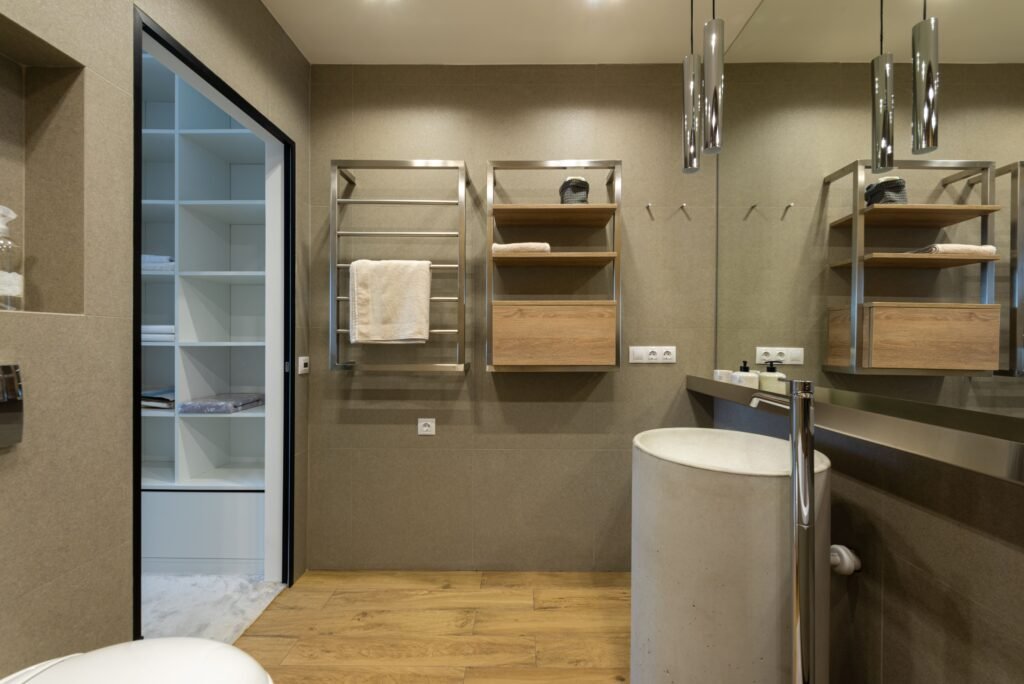
Towel rail. “Towel rail” gets used two ways. In North America, it is a synonym for a towel bar. In the UK, Australia, and parts of Asia, however, it refers to a ladder-style heated towel rail or a multi-bar wall unit. Because of this, we ask for a reference image when quoting, since the two products have completely different tooling.
Towel rack. A larger unit with multiple horizontal bars or a shelf, designed to hold several towels at once. Racks are wider, project further from the wall, and therefore need heavier-duty wall anchors than a single towel bar.
Double towel bar. A single wall fixture with two parallel horizontal bars. It doubles capacity without taking up more wall width. The bars are usually 20 to 30 cm apart vertically, and the whole unit projects 12 to 15 cm from the wall. Double towel bars are common in hotels and shared bathrooms.
For the rest of this guide, “towel bar” refers to the standard single-bar wall fixture unless stated otherwise. The production principles apply across all four types.
Materials That Hold Up in a Damp Room
Bathroom humidity attacks towel bars in predictable ways: rust at the end post joints, peeling plating on the bar surface, and corrosion around screw holes. The base material and the plating thickness both determine how fast this happens.
304 stainless steel. The default material for hotel and high-use bathroom projects. It resists rust, handles constant humidity, and does not need a protective coating. Brushed 304 is the standard finish — it hides fingerprint marks and water spots better than mirror polish. For a towel bar, the bar tube should be 0.8 to 1.2 mm thick, and the end posts should be machined from solid bar stock rather than pressed from thin sheet.
201 stainless steel. A lower-cost material for budget product lines. It contains less nickel than 304, so it rusts faster in coastal or continuously damp environments. It is acceptable for powder-coated finishes in guest bathrooms where the bar is wiped down daily, but we do not recommend it for uncoated shower-area use.
Brass with electroplating. Premium hardware brands order brass towel bars for the weight and feel. The brass body is electroplated with chrome, brushed nickel, matte black, or gold. Plating thickness decides the lifespan. We plate standard orders at 8 to 12 microns, and high-end lines at 15 to 20 microns. The difference is invisible in a showroom but obvious after two years of daily use.
Zinc alloy. Common in low-cost retail towel bars. Zinc casts easily into complex end post shapes and takes plating well. It is brittle compared to brass or stainless, and it can crack at the joint if over-tightened during installation. We produce zinc towel bars for entry-level markets, but we do not recommend them for hotel or heavy-use settings.
Aluminum. Lightweight and corrosion-resistant. Used mainly for matte black, white, or colored towel bars with a powder-coated finish. Aluminum end posts need a thicker wall than zinc to match the same rigidity, and the bar itself is usually aluminum extrusion.
For most wholesale buyers, the safe specification is 304 stainless steel, brushed finish, bar tube 1.0 mm minimum, solid stainless end posts. It costs more than zinc or 201, but the warranty exposure is far lower. We covered finish durability in more detail in our guide to bathroom hardware finishes.
Sizing and Installation Dimensions That Affect the Order
Towel bar sizes are not arbitrary. They follow standard towel dimensions, and getting the size wrong means the product does not fit the user’s towels.
Bar Length
A standard hand towel is 40 to 50 cm wide. A standard bath towel is 70 to 80 cm wide. A towel bar needs to be at least the width of the towel to let it hang without bunching. The most common bar lengths we produce are 45 cm, 60 cm, and 75 cm. Hotel orders trend toward 60 cm for hand towels and 75 cm for bath towels.
Projection from Wall
The distance between the wall and the center of the bar determines how easily a folded towel fits. 60 to 70 mm is standard for a single bar. 90 to 110 mm gives more air circulation and suits thicker bath sheets. For double towel bars, projection runs 120 to 150 mm because the rear bar also holds a towel.
Mounting Hole Spacing
The distance between the two wall plate mounting holes varies with bar length. A 60 cm towel bar typically has mounting holes 48 to 52 cm apart. We provide a drilling template with every retail box and a dimensional drawing with every bulk order. A product that ships without a template generates installation complaints.
Height from Floor
We do not install the product, but we get asked this often. The standard mounting height is 105 to 120 cm from the finished floor for a hand towel bar, and 110 to 125 cm for a bath towel bar. If the bar serves a children’s bathroom or an accessible bathroom, the spec changes to 90 to 100 cm.
These dimensions should appear in your catalog copy and on the packaging. They reduce returns because the customer knows what they are getting before they open the box.
Price Ranges for Bulk Towel Bar Orders
The figures below are FOB China unit prices for standard brushed finishes, based on order volumes of 500 to 2,000 pieces. Custom packaging and special finishes add cost.
| Towel Bar Type | 201 Stainless | 304 Stainless | Brass + Plating |
|---|---|---|---|
| Single bar 45 cm | $1.50–$2.80 | $2.80–$4.80 | $5.00–$8.50 |
| Single bar 60 cm | $1.80–$3.20 | $3.20–$5.50 | $5.80–$9.50 |
| Single bar 75 cm | $2.20–$3.80 | $3.80–$6.50 | $6.50–$11.00 |
| Double bar 60 cm | $3.50–$5.50 | $5.50–$9.00 | $9.50–$15.00 |
Price differences between 201 and 304 are mostly material cost. The jump from 304 to brass is plating thickness and base metal price.
The biggest variables after material are wall plate design, finish type, and packaging. A square wall plate costs more to machine than a round plate. Matte black plating runs 10 to 20 percent higher than chrome because the process needs an extra topcoat. Individual retail boxes with foam inserts cost $0.40 to $0.90 per unit more than bulk poly bag packing. These details matter when you are calculating landed cost across a container of mixed hardware.
What to Check Before Confirming a Towel Bar Order
Five things cause most towel bar problems. Check them before production, not after.
Joint Strength
The bar connects to the end posts either by threading, welding, or grub screws. A threaded connection with a set screw is the strongest. A cheap towel bar uses a thin press-fit, which loosens after a few months of towel pulling. Ask for a cross-section photo or a sample before confirming.
Wall Plate Flatness
The wall plate must sit flush against the tile. A stamped plate with sharp edges leaves a gap and scratches the surface during installation. We machine the contact face flat on all stainless and brass towel bars.
Plating Uniformity
Check inside the end post and around the screw holes. Plating that is thin or missing in hidden areas means the product will corrode from the inside. This is a common cost-cutting spot on zinc and brass towel bars.
Set Screw Finish
The tiny grub screw under the bar is the first part to rust. It should be stainless, not carbon steel. We see cheap towel bars with stainless bodies and carbon steel set screws. The bar looks fine, and then a rust line drips down the wall.
Packaging Protection
A towel bar in a thin poly bag arrives scratched. If the product is retail, it needs an individual box or at least a foam sleeve around the bar and wall plates. Bulk hotel orders ship in partitioned cartons with tissue wrap. Scratched finishes on brushed stainless are not repairable — the whole unit gets returned.
If you are sourcing a towel bar for the first time, order a pre-production sample. It costs less than a single warranty claim and shows exactly what will arrive in the container.
What to Specify When Requesting a Quote
Send these details for an accurate quote:
- Type — single towel bar, double towel bar, towel rack, or heated rail
- Bar length — in centimeters or inches
- Material — 304, 201, brass, zinc, or aluminum
- Finish — brushed, chrome, matte black, brushed nickel, gold, or powder-coated
- Mounting — wall plate shape and screw-hole spacing
- Packaging — bulk, individual box, or custom retail packaging
- Order volume — trial order or container quantity
- Target market — country, hotel or residential use, and certification needs
We return a quote with unit pricing, sample lead time, and production schedule. Standard production runs take 25 to 35 days after sample approval. Custom designs with new tooling add 15 to 25 days.
Towel bars ship from our factory in Jiangmen, China, alongside faucets, shelves, and other bathroom hardware. If you need a matched set across multiple product categories, we match the finish and design language from your existing samples or catalog photos. Send your specifications and you will have a full quote within two business days.